

If you have ever typed your age, weight, and activity level into a calorie calculator and wondered whether the result means anything in real life, you are not alone. Most people want a simple number. What they actually need is a useful starting point they can trust, test, and adjust.
A good calorie calculator can help you lose fat, maintain your weight, support muscle gain, or simply understand how much energy your body uses each day. The problem is that many tools give a number without context. This guide fixes that. You will learn what a calorie calculator does, how the main formulas work, how to pick the right activity level, which free tools are worth using, and how to turn one estimate into a practical plan.
What Is a Calorie Calculator and Why It Matters
Definition of calories and caloric needs
A calorie is a unit of energy. In nutrition, it describes how much energy food provides and how much energy your body uses to stay alive, move, digest food, and recover from activity. Think of calories as your body’s fuel budget. Every day, your body spends energy on basic functions like breathing and circulation, then spends more on walking, training, working, and everything else you do.
Your caloric needs are the total number of calories required to maintain your current weight. Eat consistently above that level and weight tends to increase over time. Eat consistently below it and weight tends to decrease. That sounds simple, and at a high level it is. But the exact number varies by body size, muscle mass, age, sex, genetics, health status, and activity patterns.
This is where a calorie calculator becomes useful. It does not tell you the perfect number for life. It gives you a data-informed estimate that is good enough to begin with.
How calorie calculators work
Most calorie calculators estimate two key values: BMR and TDEE.
BMR, or basal metabolic rate, is the number of calories your body would burn at complete rest over 24 hours. It is the energy needed for basic survival, not for exercise or normal daily movement. Popular formulas such as Mifflin-St Jeor and Harris-Benedict estimate BMR using age, sex, height, and weight.
TDEE, or total daily energy expenditure, takes that resting number and multiplies it by an activity factor. That activity multiplier accounts for exercise, walking, chores, work demands, and general movement. A sedentary person may use a multiplier around 1.2, while a highly active person may fall closer to 1.7 to 1.9.
The relationship is straightforward: BMR × activity multiplier = TDEE. If your estimated BMR is 1,500 calories and your activity factor is 1.55, your estimated TDEE is about 2,325 calories.
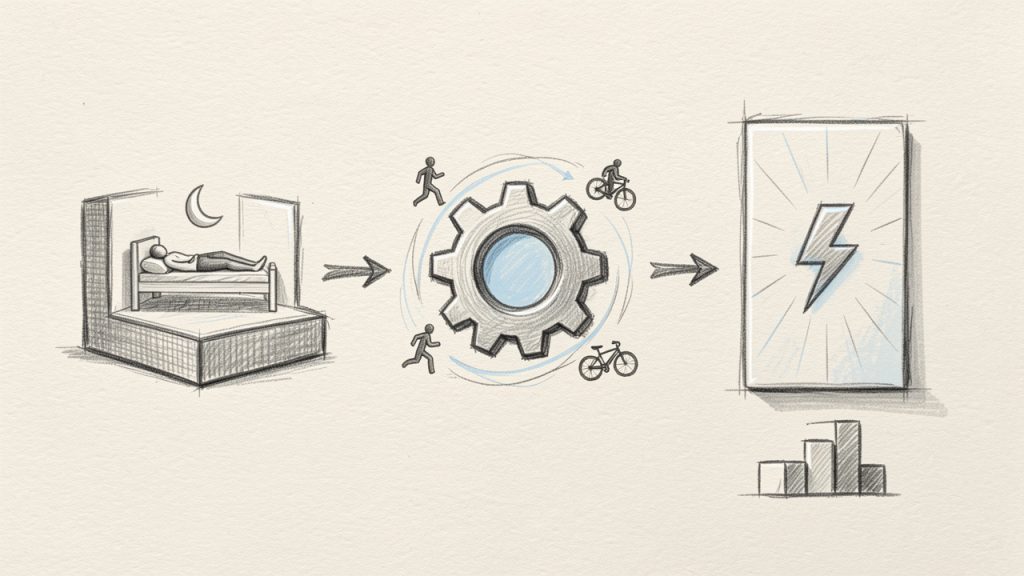
That number becomes your starting point for maintenance. From there, you adjust up or down based on your goal.
Who benefits from using a calorie calculator
A calorie calculator is helpful for far more than weight loss. Someone trying to lose body fat can use it to create a moderate calorie deficit. Someone struggling to gain weight can use it to build a controlled surplus. A person who wants to maintain weight while improving food quality can use it as a reality check.
Athletes often use calorie calculators to support training, recovery, and performance. In medical settings, calorie estimates can inform nutrition planning for older adults, patients managing chronic disease, or people recovering from illness, although these cases often require professional oversight.
For everyday users, the value is practical. Instead of guessing, you begin with a reasoned estimate. That alone can save weeks of frustration.
How to Use a Calorie Calculator: Step-by-Step Guide
Gather the required inputs
A typical calorie calculator asks for age, sex, height, weight, activity level, and goal. These inputs matter because they influence how much energy your body is likely to use.
Age matters because metabolism often declines gradually over time, partly due to changes in lean body mass and activity. Sex matters because males and females usually differ in body composition and hormonal profile. Height and weight matter because larger bodies generally require more energy.
The most commonly misreported input is activity level. Many people choose “moderately active” because they work out a few times a week. But if they sit at a desk most of the day and only train for 30 minutes, their real-world expenditure may be lower than expected. A calculator is only as good as the inputs you give it.
Choosing the right formula
For most adults, Mifflin-St Jeor is the best default. It is widely considered more accurate than older formulas for modern populations and is commonly used in reliable calorie calculator tools.
Harris-Benedict is older and still common, but it can overestimate needs in some users. It is not useless, just less favored when a more current option is available.
Katch-McArdle can be useful if you know your body fat percentage with reasonable accuracy. Because it uses lean body mass, it may better reflect calorie needs in very muscular individuals. The catch is that many body fat estimates from home scales are rough. If the body fat number is wrong, the result can drift.
Setting your goal: loss, maintenance, or gain
Once you have a maintenance estimate, the next step is adjusting it for your goal. For weight loss, a moderate deficit of about 10 to 20 percent below maintenance is often a smart starting range. Another common method is subtracting about 300 to 500 calories per day.
For weight gain, a smaller surplus often works better than people expect. Roughly 150 to 300 calories above maintenance can be enough for gradual lean mass gain, especially in trained individuals trying to minimize fat gain.
For maintenance, stay near estimated TDEE and watch the trend over a few weeks. Day-to-day scale changes mean very little on their own. The trend matters.
As a rough rule, a daily deficit of 500 calories is often associated with about one pound of weight loss per week, but the classic 3,500 calories per pound rule is only a broad approximation. Real bodies adapt, and the rate often slows over time.
Adjusting for special circumstances
Pregnancy, breastfeeding, older age, high-volume athletic training, thyroid disorders, diabetes, and certain medications can all affect calorie needs. In these cases, a calorie calculator is still useful, but it should be treated more cautiously.
Older adults may need fewer calories overall, with more emphasis on protein, strength training, and nutrient density. Athletes may need significantly more energy than generic calculators predict, especially during heavy training blocks. People with metabolic or endocrine conditions should consider input from a doctor or registered dietitian before making aggressive changes.
Common Formulas Explained (with Examples)
Mifflin-St Jeor formula
The Mifflin-St Jeor equation estimates resting calorie needs using weight in kilograms, height in centimeters, age in years, and sex.
For men: BMR = 10 × weight + 6.25 × height – 5 × age + 5
For women: BMR = 10 × weight + 6.25 × height – 5 × age – 161
Take a 35-year-old woman who weighs 70 kg and is 165 cm tall. Her estimated BMR would be:
10 × 70 = 700
6.25 × 165 = 1031.25
5 × 35 = 175
So, 700 + 1031.25 – 175 – 161 = 1395.25 calories per day
If she is lightly active, using a multiplier of 1.375, her estimated TDEE is about 1,919 calories. If her goal is fat loss, a 15 percent deficit would put her near 1,630 calories per day.
Harris-Benedict equation
The Harris-Benedict formula is another classic method. It remains popular because it is simple and familiar, but it is older and may be less accurate for some people.
Its main advantage is historical use and availability in many tools. Its main drawback is that newer equations often perform better in contemporary settings. If a calorie calculator uses Harris-Benedict, the result is still a helpful estimate, but you should be ready to validate it against actual progress.
Katch-McArdle formula
The Katch-McArdle formula is especially relevant when body fat percentage is known:
BMR = 370 + (21.6 × lean body mass in kg)
Suppose a 90 kg man has 20 percent body fat. His lean body mass is 72 kg. That gives:
370 + (21.6 × 72) = 370 + 1555.2 = 1925.2 calories
If he trains hard and falls around an activity factor of 1.55, his TDEE is roughly 2,984 calories. For a lean bulk, he might start at 3,150 to 3,250 calories and monitor weekly trends.
Quick estimates and online calculators vs clinical measures
Online tools are convenient, free, and usually accurate enough to start. They are not the same as clinical measurement. More advanced methods such as indirect calorimetry, DEXA, and bioelectrical impedance can provide more data, especially around body composition, but they cost more and are not always necessary.
For most people, the best approach is simple: use a reputable calorie calculator, apply a sensible goal adjustment, then compare the estimate with your real-world results over 2 to 4 weeks.
Activity Levels and Accurate Estimation
Defining activity multipliers
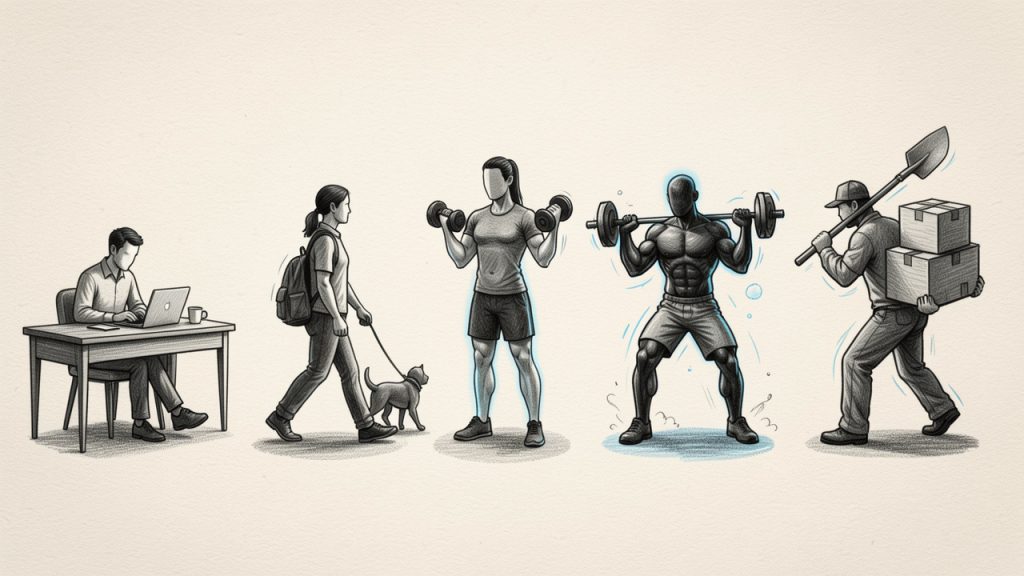
Choosing the right activity level is where many calorie calculator estimates go off track. The labels sound simple, but daily life is messy. Someone can train four times per week and still have a mostly sedentary lifestyle if the rest of the day is spent sitting.
Here is a practical guide:
| Activity Level | Multiplier | Typical Profile |
|---|---|---|
| Sedentary | 1.2 | Desk job, little exercise, low daily movement |
| Lightly active | 1.375 | Light exercise 1 to 3 days per week, some walking |
| Moderately active | 1.55 | Moderate exercise 3 to 5 days per week, decent daily movement |
| Very active | 1.725 | Hard training 6 to 7 days per week, active job or lots of movement |
| Extra active | 1.9 | Intense training, physical labor, or two-a-day sessions |
Estimating real activity
A more accurate estimate includes NEAT, which stands for non-exercise activity thermogenesis. This is the energy you burn from walking around, standing, fidgeting, doing errands, and handling normal tasks. For many people, NEAT has a larger impact than formal workouts.
Occupational activity matters too. A warehouse worker, nurse, landscaper, or server will often have much higher daily expenditure than a remote office worker, even if their gym time is the same.
Common mistakes to avoid
The biggest mistake is counting workouts twice. If you choose a higher activity multiplier because you exercise regularly, do not also add large chunks of “exercise calories” on top unless your tool is designed for that method.
Another frequent issue is trusting treadmill or smartwatch calorie numbers as precise. They can be directionally useful, but they are not exact. Wearables are often better at measuring steps and activity patterns than true calorie expenditure.
Tools to track activity
Wearables, heart rate monitors, step counts, and activity logs can all help you refine your estimate. The smart way to use them is not to believe every calorie number. Use them to understand patterns. Are you averaging 3,000 steps or 11,000? Are you active only during workouts, or all day?
That pattern gives context to your calorie calculator result and helps you choose a more realistic multiplier.
Personalizing Calorie Targets: Beyond the Calculator
Monitoring progress and adjusting calories
A calorie calculator gives you a starting point. Your body provides the final answer. After 2 to 4 weeks, review your average body weight, measurements, energy, hunger, and training performance.
If your goal is fat loss and your weekly average weight is barely changing, reduce intake by about 100 to 200 calories per day or increase movement slightly. If weight is dropping too fast and energy is poor, add back 100 to 200 calories.
A practical decision rule helps. If you want to lose weight and the trend is less than about 0.5 lb per week, tighten calories modestly. If you are trying to gain and nothing changes for several weeks, increase by 150 to 200 calories daily.
Macronutrients and meal timing
Calories matter most for weight change, but macronutrients shape how that process feels and performs. Protein is especially important for satiety and muscle retention. Many active adults do well with roughly 1.6 to 2.2 grams of protein per kilogram of body weight, especially during weight loss or muscle gain phases.
Carbohydrates support training and recovery. Fats support hormones and overall nutrition. Meal timing is not magic, but it can help with adherence. Some people manage hunger better with larger meals. Others prefer spreading food across the day.
The best plan is not the most impressive one. It is the one you can follow consistently.
Psychological and behavioral factors
The most accurate calorie calculator in the world cannot fix an unsustainable plan. If your target leaves you constantly hungry, socially isolated, or mentally exhausted, adherence will collapse.
High-volume foods, consistent meal structure, adequate protein, sleep, and stress management all make calorie targets easier to follow. This is where many people succeed or fail. The number matters. The system matters more.
When to seek professional guidance
If you have a medical condition, a history of disordered eating, major weight changes, unexplained fatigue, or sports performance goals, professional support can save time and reduce risk. A registered dietitian, doctor, or sports nutritionist can interpret your calorie calculator result within the context of health, labs, medications, and lifestyle.
Common Questions and Myths About Calorie Counting
Will all calories affect weight equally?
At the level of body weight, total calorie intake still drives the main trend. But not all calories affect your body in the same way. Protein has a higher thermic effect, meaning your body uses more energy to digest it. Different foods also vary in satiety, which affects how much you naturally eat later.
So yes, 2,000 calories is still 2,000 calories in energy terms. But 2,000 calories from minimally processed, protein-rich meals often feels very different from 2,000 calories of highly refined snack foods.
Is counting calories necessary for health?
No. Many healthy people never count calories. A calorie calculator is a tool, not a requirement. Some users prefer portion guides, habit-based coaching, or hunger-based eating.
Still, calorie counting can be extremely useful when progress has stalled, goals are specific, or awareness is low. It is often better viewed as a temporary skill than a lifelong obligation.
Do metabolic adaptations make calculators useless?
No. They make calculators imperfect, not useless. During dieting, energy expenditure can decrease through lower body mass, reduced movement, and metabolic adaptation. During overfeeding or increased training, expenditure can also shift.
This is exactly why a calorie calculator should be paired with monitoring and adjustment. The estimate gets you close. The feedback loop gets you accurate.
Are calorie counts on food labels accurate?
Food labels are helpful, but not exact. There can be error in both labeling and portion measurement. Restaurant calorie counts can vary even more. That does not mean tracking is pointless. It means you should think in ranges, not pretend every number is exact to the single calorie.
Practical Tools: Best Free Calorie Calculators and Apps
What to look for in a good tool
A good calorie calculator should be clear about its formula, easy to use, and realistic about limitations. Transparency matters. If a tool gives you a number but does not explain BMR, TDEE, or activity assumptions, it is less useful than it looks.
Personalization also matters. Some tools are better for general weight management, while others are stronger for athletes, macro planning, or habit tracking.
Recommended free calorie calculators and apps
| Tool | Domain | Best For | Pros | Cons |
|---|---|---|---|---|
| MyFitnessPal Calculator and App | myfitnesspal.com | Weight loss, food logging, general users | Large food database, easy tracking, integrates with wearables | Food entries can vary in accuracy, some features locked behind premium |
| Precision Nutrition Calculator | precisionnutrition.com | Habit-based coaching, macro guidance | Practical recommendations, behavior-friendly approach | Less detailed for users who want deep manual control |
| Nike Training / Nike ecosystem tools | nike.com | Active users combining training and nutrition awareness | Strong fitness ecosystem, useful for active routines | Not primarily a dedicated calorie calculator |
| Calculator.net Calorie Calculator | calculator.net | Quick web-based estimates | Fast, transparent, includes formula logic | More functional than personalized |
| Mayo Clinic calorie tools and health resources | mayoclinic.org | Health-conscious users seeking trusted context | Strong health credibility, accessible guidance | Less flexible than tracker-first apps |
How to choose based on your goal
If your main goal is fat loss and you want daily logging, a tracker such as MyFitnessPal is often the most practical. If you dislike obsessive tracking and prefer broader guidance, Precision Nutrition’s style may feel more sustainable.
If you are focused on athletic performance, choose a tool that works alongside training data, body weight trends, and macro planning. If your use case is clinical monitoring or health management, prioritize trustworthy health institutions and professional guidance over flashy app features.
Case Examples and Worksheets
Sample profile 1: Sedentary adult losing weight
Consider a 42-year-old woman, 165 cm tall, 82 kg, desk job, walking occasionally, no structured training. Using Mifflin-St Jeor:
BMR = 10 × 82 + 6.25 × 165 – 5 × 42 – 161
BMR = 820 + 1031.25 – 210 – 161 = 1480.25
With a sedentary multiplier of 1.2, TDEE is about 1776 calories. A 15 percent deficit gives a target near 1510 calories.
If after 4 weeks her average loss is only 0.2 lb per week, she could reduce by another 100 to 150 calories or increase daily steps meaningfully.
Sample profile 2: Young athlete gaining lean mass
Now take a 23-year-old man, 180 cm, 75 kg, resistance training 5 days per week, active campus lifestyle.
Mifflin-St Jeor gives:
BMR = 10 × 75 + 6.25 × 180 – 5 × 23 + 5
BMR = 750 + 1125 – 115 + 5 = 1765 calories
With a multiplier of 1.55, TDEE is about 2736 calories. For gradual lean mass gain, a surplus of 250 calories gives a target around 2985 calories.
If body weight does not increase after 3 to 4 weeks, raising intake to about 3135 calories may be reasonable.
Sample profile 3: Middle-aged adult maintaining weight
A 50-year-old man, 178 cm, 85 kg, walks daily and lifts 3 times per week.
BMR = 10 × 85 + 6.25 × 178 – 5 × 50 + 5
BMR = 850 + 1112.5 – 250 + 5 = 1717.5 calories
At a moderate activity factor of 1.55, estimated TDEE is about 2662 calories. If his goal is maintenance, he might begin around 2600 to 2700 calories and adjust based on a 2 to 4 week weight trend.
Printable quick worksheet
| Input | Your Number |
|---|---|
| Age | |
| Sex | |
| Height | |
| Weight | |
| Estimated body fat % (optional) | |
| Activity level | |
| Formula used | |
| BMR | |
| TDEE | |
| Goal | |
| Calorie target | |
| Protein target | |
| Average weekly weight change | |
| Adjustment after 2 to 4 weeks |
Use this decision rule: if progress is slower than expected for 2 to 4 weeks, adjust calories by 100 to 200 per day. If progress is too fast and recovery, mood, or performance are suffering, bring calories up modestly.
Safety, Special Considerations, and FAQ
Safe calorie limits and warning signs
Aggressive calorie restriction can backfire quickly. Very low-calorie diets should not be self-directed without medical supervision. Persistent dizziness, fatigue, irritability, menstrual disruption, binge eating, poor training recovery, and obsessive thoughts about food are signs that your current plan may be too aggressive.
As a general principle, aim for a moderate deficit, not the fastest possible result. Sustainable progress almost always wins.
Medical conditions and special populations
People with diabetes, thyroid disease, gastrointestinal disorders, kidney disease, or a history of eating disorders should not rely on a calorie calculator alone. Pregnancy, breastfeeding, and adolescence also require special care because energy needs are dynamic and nutrient demands are high.
If there is any concern about disordered eating behaviors, professional support matters more than any number on a calculator. In the United States, support can begin through organizations such as the National Eating Disorders Association (nationaleatingdisorders.org) or a licensed clinician.
Short FAQ
A calorie calculator is usually best treated as a starting estimate, not a final prescription.
For weight loss, a moderate 10 to 20 percent deficit is often more sustainable than a large cut.
For muscle gain, a small surplus usually works better than a large surplus if you want to limit excess fat gain.
If your results do not match the estimate after 2 to 4 weeks, adjust the target rather than abandoning the process.
Conclusion and Next Steps
A calorie calculator works best when you understand what it is actually estimating. It uses formulas such as Mifflin-St Jeor, Harris-Benedict, or Katch-McArdle to estimate resting needs, then scales them using activity to predict your daily energy expenditure. That estimate is useful, but only when paired with honest inputs, realistic goals, and follow-up adjustments.
Your next step is simple. Choose a reputable calculator, enter accurate data, pick a modest goal, and track your average progress for the next 2 to 4 weeks. Then adjust by 100 to 200 calories if needed. That is how a calorie calculator becomes a real decision-making tool instead of just another number on a screen.